Open source
OpenLens
Your first open-source PR, mapped out. Five questions, then a guide for that repo.

I build software, and the tools that help people understand it.
A search engine for your whole codebase. Every answer cites the lines it stands on.
fastapi/full-stack-fastapi-template · flow ft-login, one of 101 hand-labelled flows in CrossLayerBench
Every engineer knows the first week in a new codebase. You grep, you guess, and you ask someone who's busy. The answer is in the code, spread across the page, the API, the services and the database.
I built OpenLens first, to get people to their first open-source pull request. It found the right issue and the files to touch, but it never read the code. repo-sensei does.
It reads every commit the way a careful engineer would: symbols, calls, routes and queries, across TypeScript, Python and Java. Ask it something and the answer comes from the code, every claim cited to its lines and checked against them before you see it. When the code doesn't say, neither does it.
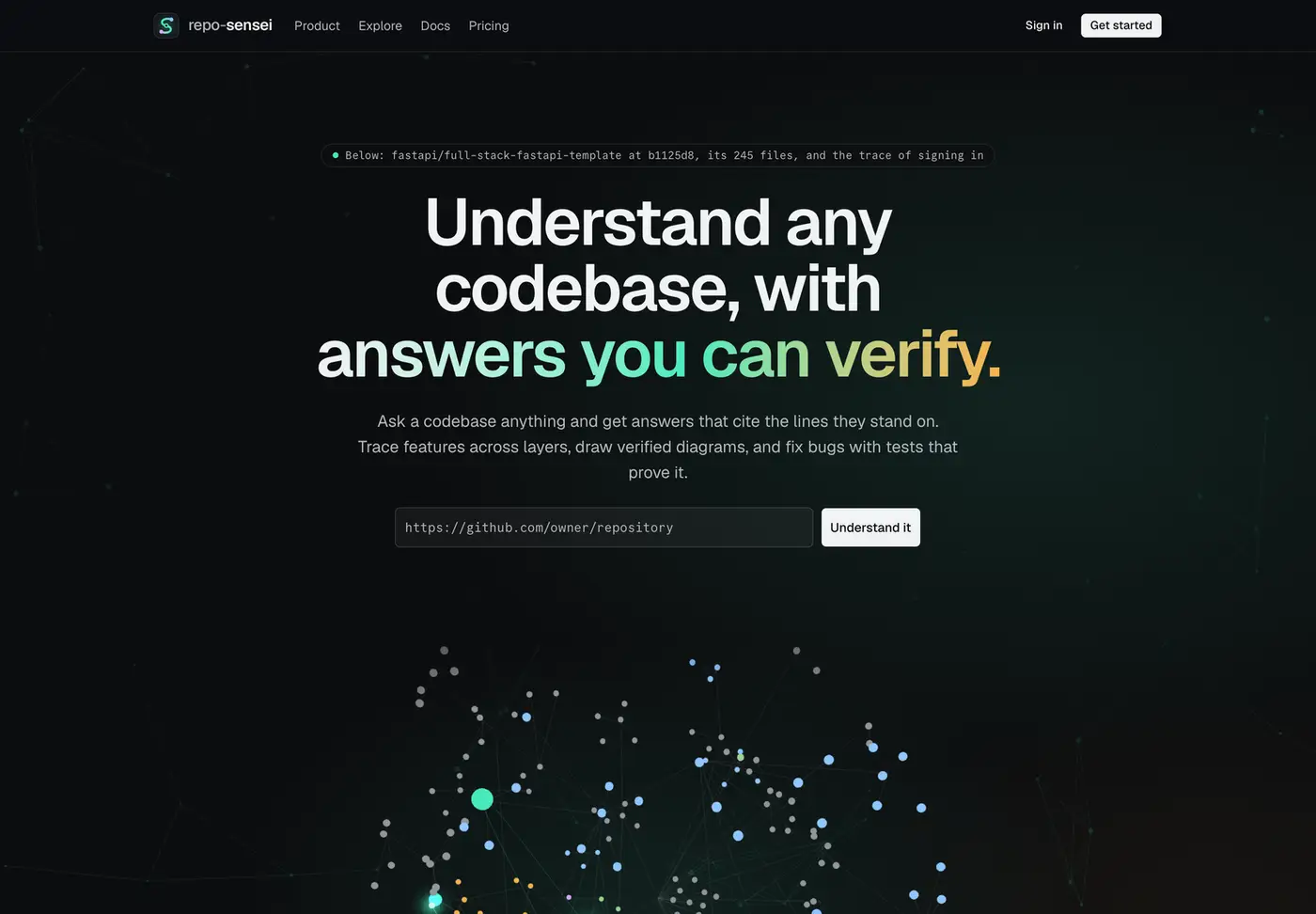
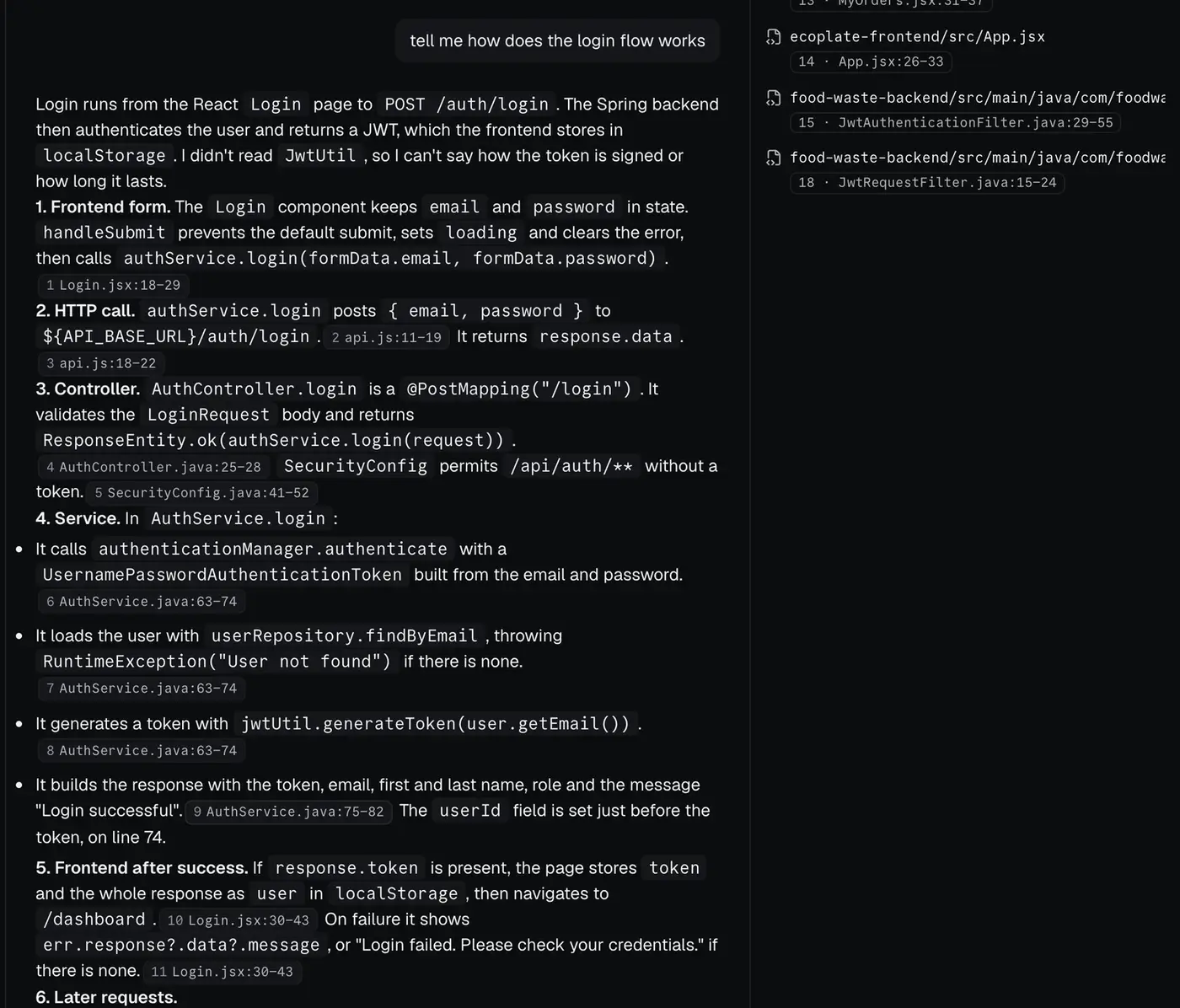
Questions about the code, answered from the code. Each claim is checked against the lines it cites, and an answer it can't stand behind says so.
Follow a feature from the button to the database: UI, API, services and storage, hop by hop, across languages.
Drawn from the code's graph, each edge checked, and marked when it no longer matches.
Modules, packages and cycles, and what a change to a symbol reaches before you make it.
Read any tracked branch. Answers say when what they cited has changed since.
The same index from Claude Code, Cursor or VS Code, signed in once with OAuth or an API key.
From a stack trace or an issue: reproduced by a failing test, planned for your approval, patched in a sandbox and verified by your tests.
I hold it to a benchmark I built and published. 0.95 hop recall on the repo I tuned it on, 0.23 to 0.33 on repos it has never seen. The second number is the one I'm working on.
* tuned on. 101 hand-labelled flows over five open-source full-stack repositories; the tracer makes no model calls.
GitHub ─webhooks─▶ API (FastAPI) ─▶ Postgres: pgvector, BM25, row-level security
                     │                      ▲
  web (Next.js) ─────┘   Redis queues ─▶ workers (Celery): parse, embed, graph, index,
Ask and Fix agents ─▶ Docker + gVisor sandbox3+ years building software, mostly the backend.
Your first open-source PR, mapped out. Five questions, then a guide for that repo.
Answers over your lecture slides, each one pointing back to the slide it came from.
New job postings from Greenhouse, Lever and Ashby, freshest first.
My portfolio, as an operating system. Windows, dock, Spotlight, a real shell. No UI kit.
Surplus groceries, discounted before they expire. What's left goes to NGOs.
Live speech, read for sentiment, drawn as generative art.
The demos run on free tiers and nap when idle. Give the first request about 50 seconds.
Multi-AZ Terraform, Packer-built AMIs, CI to deploy.
Reserve a charger before you drive there.
A Transformer written by hand in PyTorch, plus RAG.
Live polling over WebSockets, where attendance comes from answering.
What I reach for, and what I've shipped with.
“Beware of bugs in the above code; I have only proved it correct, not tried it.”
962 contributions in the last year
145 problems solved
Open to software engineering roles. Boston, happy to relocate.